
ProTunes One (Product)
Took over live product design for a web app with 100,000+ subscribers, running search, onboarding, and localization improvements that lifted free-to-paid conversion from 24% to 33% and quadrupled weekly signups.

Project Name
ProTunes One A.I. Music
Headquarters
Dresden - Berlin - Dublin
Industry
A.I./Music
Timeline
December 2024 - January 2025
Live Product:
Index
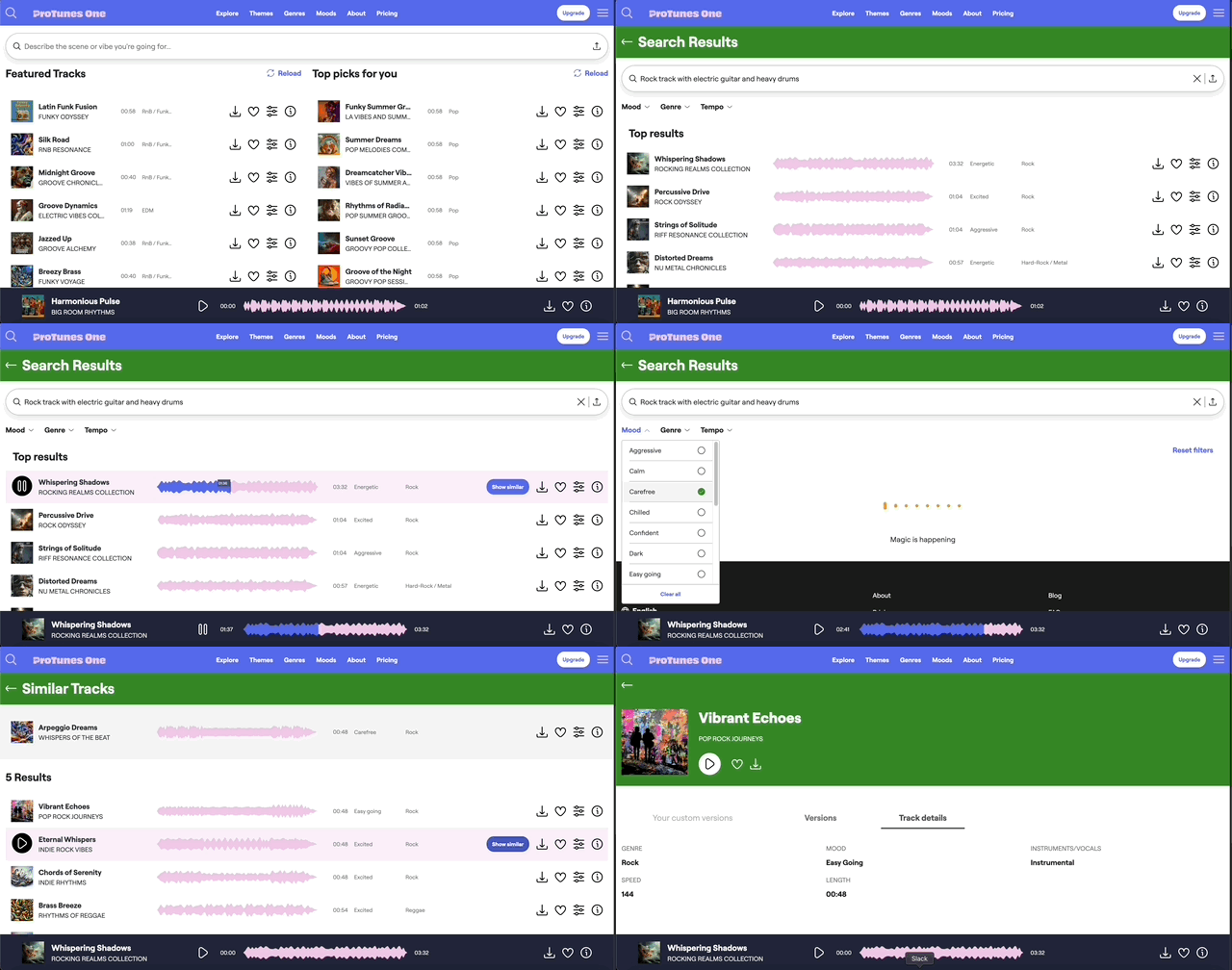
1. OVERVIEW
As Senior product designer at ProTunes One, I have continued the existing platform and played a pivotal role in securing €1.5m in additional funding. Working with a small team, we've together delivered multiple improvements that presented positive growth signs.
Contributed to:
- Reaching 100,000 subscribers and 50,000 active subscribers milestones during my stay
- Securing additional €1,5 million seed funding from sole investor
- Monthly signup growth from c.a. 250 to 1000 users week on week
- Improved free-to-paid conversion rate to 33%, up from 24% at the start of the year.
- Introduction of contextual and visual A/B tests across the platform which improved CTR's by up to 20%
- Lowered monthly churn to 2.4%, supported by clearer licensing, better recommendations, and playlist retention mechanics.
- Expanded reach to additional non-English markets by introducing multilingual support (DE, NL, IT, ES, PT)
What is ProTunes One?
ProTunes One is a subscription-based WebApp providing content creators with an AI-driven library of royalty-free background music. The platform solves the friction of music licensing by offering tracks generated through a unique hybrid of human loops and AI technology, ensuring they are 100% copyright-safe for publishing on any platform without additional royalties or claims. It serves both desktop and mobile users with tiered subscription plans for various needs, from personal projects to commercial advertising.
Key Problem
At its heart, ProTunes One is addressing a long-standing tension between creative freedom and music licensing friction. For most creators, using music legally is far more complex than it needs to be. What should be a seamless part of the creative workflow often becomes a slow, confusing, and fragmented process.
Whom does it impact
ProTunes One aims to address via subscription model license-free needs of people who publish weekly and think in terms of episodes, reels, edits, and brand consistency. These are primarily Content creators, streamers, podcasters, filmmakers, small agencies and individuals in the video/content sphere who are looking for an affordable, hassle-free subscription service.
2. BUSINESS NEEDS & GOALS
ProTunes One needs to grow the top of the funnel by attracting creators who need royalty-free music often but hesitate due to licensing confusion or limited budgets.
Why: Long-term recurring revenue depends on creators adopting us as a core tool in their workflow.
- Drive Predictable Subscription Revenue
- The business depends on month-over-month subscription stability.
- Need: Convert free users into paying creators and maintain low churn through clear value, reliable licensing, and workflow integration.
Personal Challenges
As the sole designer in the team, there was a lot on my plate and had to wear many different hats. Jumping between Product, marketing, coordinating with developers and stakeholders, there were quite a bit of challenging (but rewarding) things I've learned while on the job.
Hardcoded marketing pages slowing down marketing growth
A recurring operational challenge was the hardcoded state of our marketing pages, which I inherited as pages developed in Angular, rather than using a CMS. Small changes required developer cycles, turning simple updates into multi-day or even multi-week tasks. This slowed experimentation, impacted landing page optimization, and limited the flexibility we needed for campaigns and conversions. Eventually, aligning on a more modular, no-code/low-code approach became a priority which I also had majority stake of building from ground up.
Working with multiple viewports
Having specialized primarily in native mobile application design, my personal challenge was navigating the transition to designing a fully responsive web application with viewports always in mind.
Anticipating user needs
3. DESIGN PROCESS & CHALLENGE
Design
Core Product
Design System
AI-Assisted Workflows
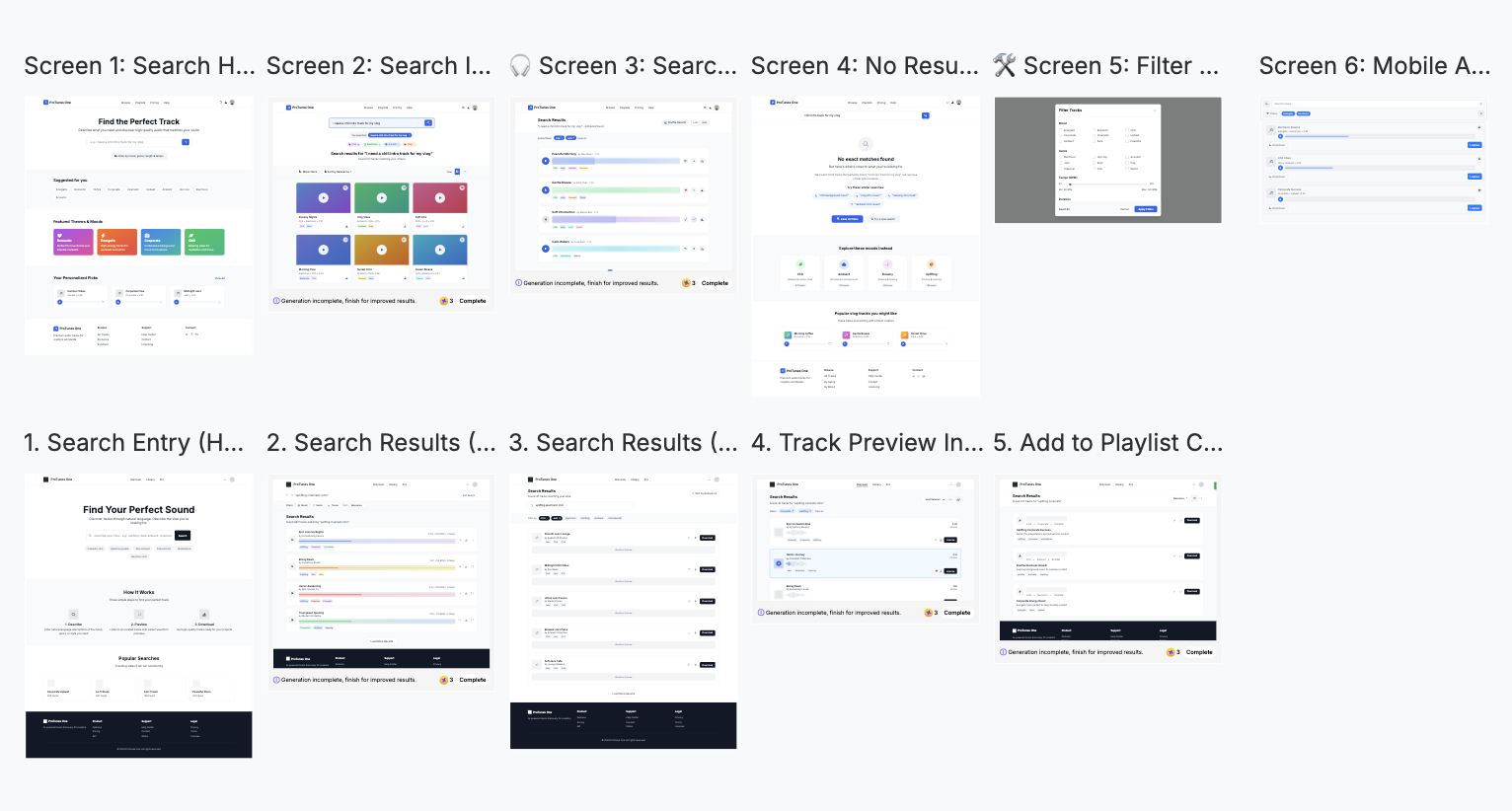
To speed up the process of ideation especially for more complex flows, I introduced UXPilot into our workflows. Most of the time, the flows worked for ideation/conceptualization, although there were artifacts that needed to be fixed.
4. KEY PROJECTS
Search Experience Overhaul
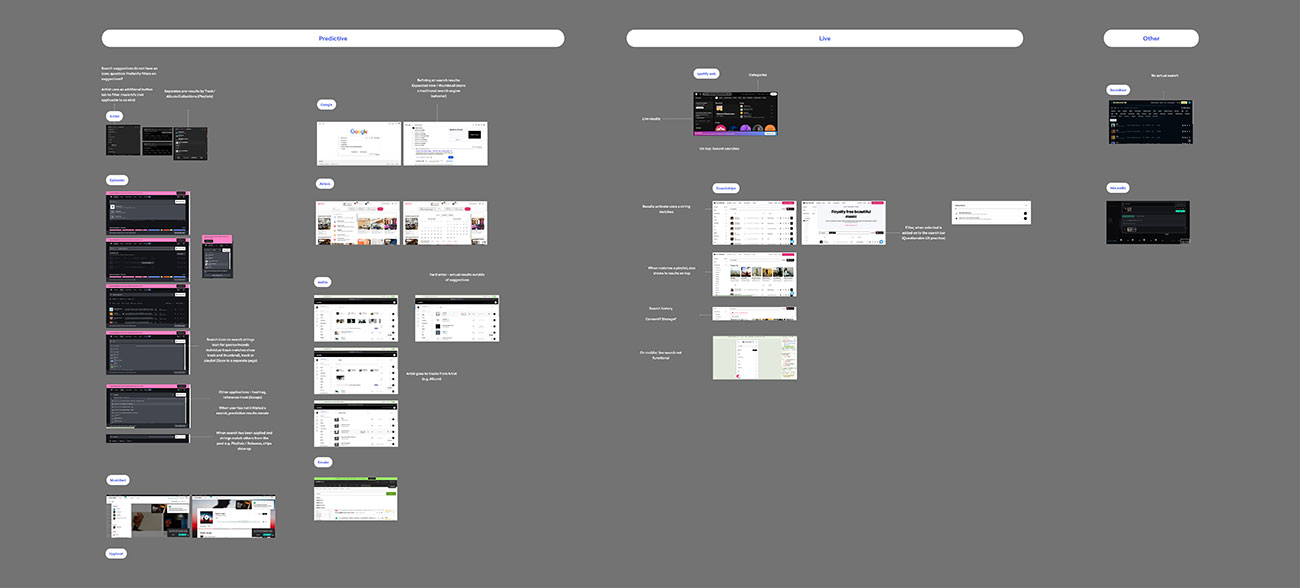
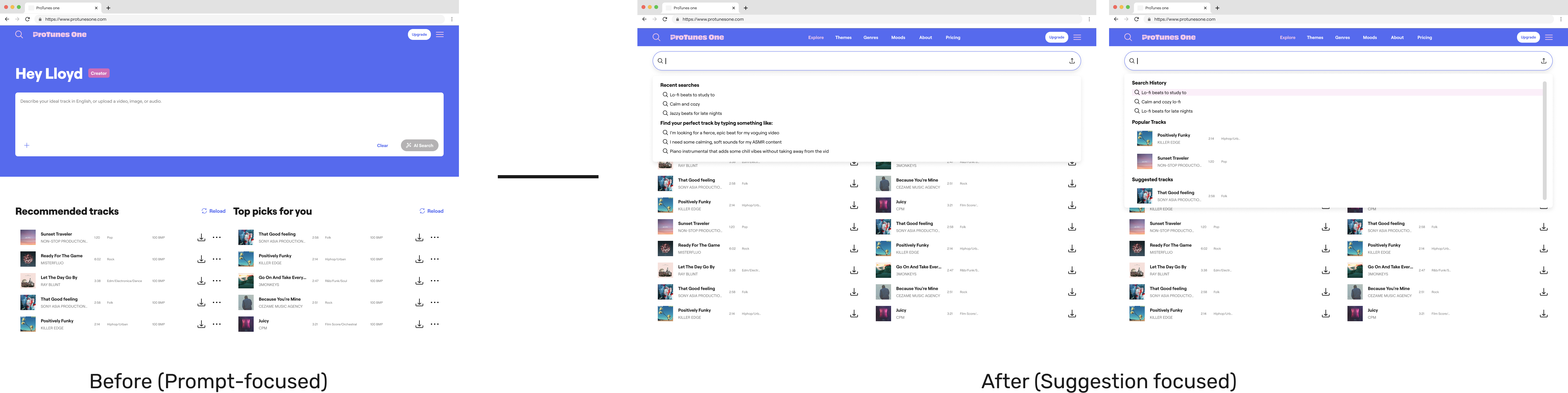
Sometimes, simplifying is the key to solving problems. With the search experience overhaul (given that the goal was to improve signups as we have this as a driving trigger for google ads) - we moved on from a prompt-based search to a general keyword search. The challenge was to find a search experience that works for the ProTunes One platform.
Initially, I did research on competitors and big name companies to see how the behavior works for each, which we had a fork in the road if we wanted to give live search results or predictive/suggestive results. We ended up going the suggestions route, as we believed that it provided more value especially to reduce friction with users. This provided reduced friction points overall and gave further user exploration. On the first week of its implementation, we've gotten a significant increase in signups/conversions and recorded our lowest CPA average at around €83/acquisition.
AI Multimodal Search
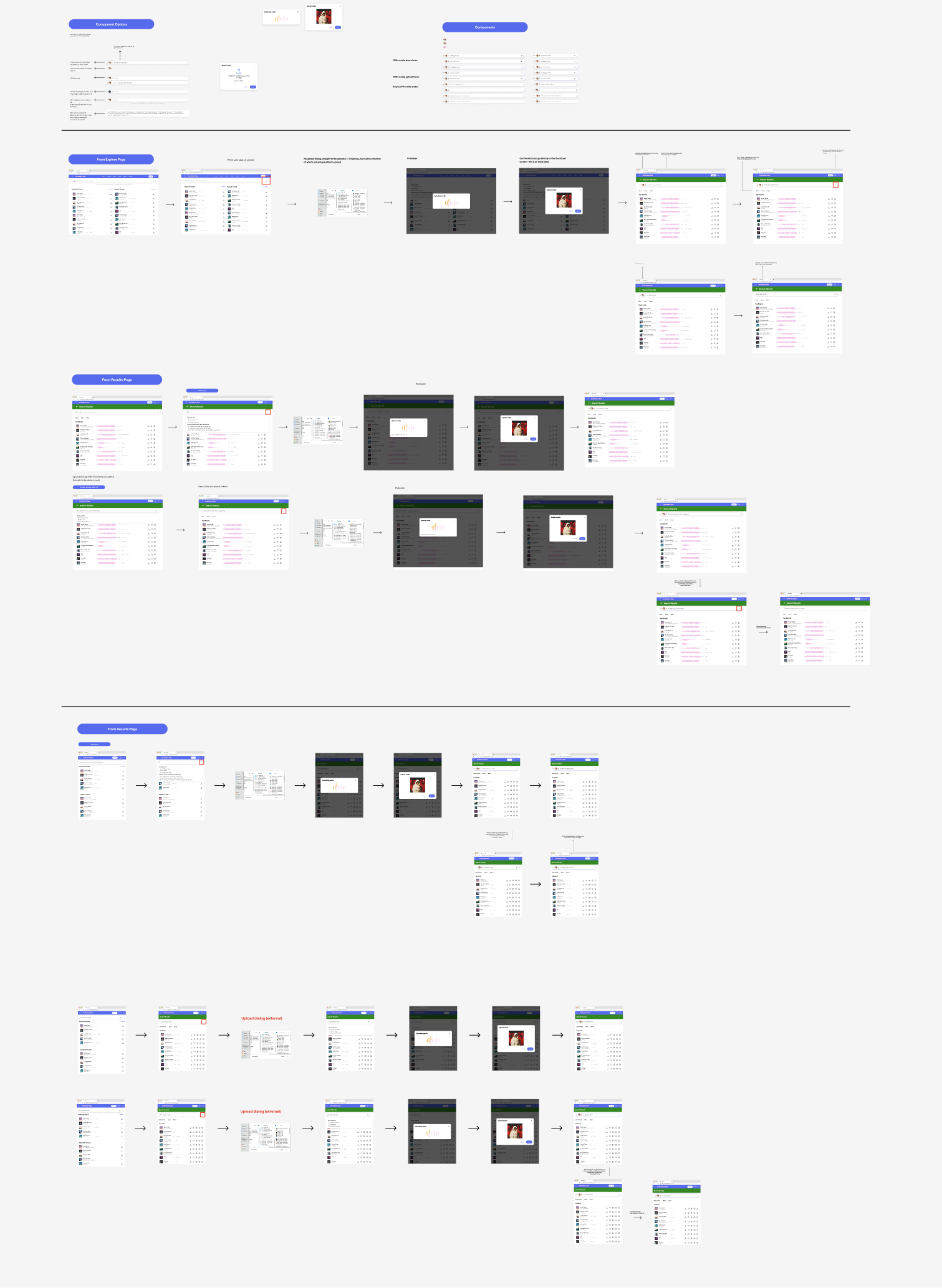
Together with the Frontend, Backend and Data Science teams and the ability to provide multimodal search (e.g. combining media files with text-based prompts) to generate more tailored search results for the users, we decided to go for this functionality as a means to provide further exploration options to the user.
Incorporated the ideation/exploration phase via Figma Make:

Context Menu for Growing Features
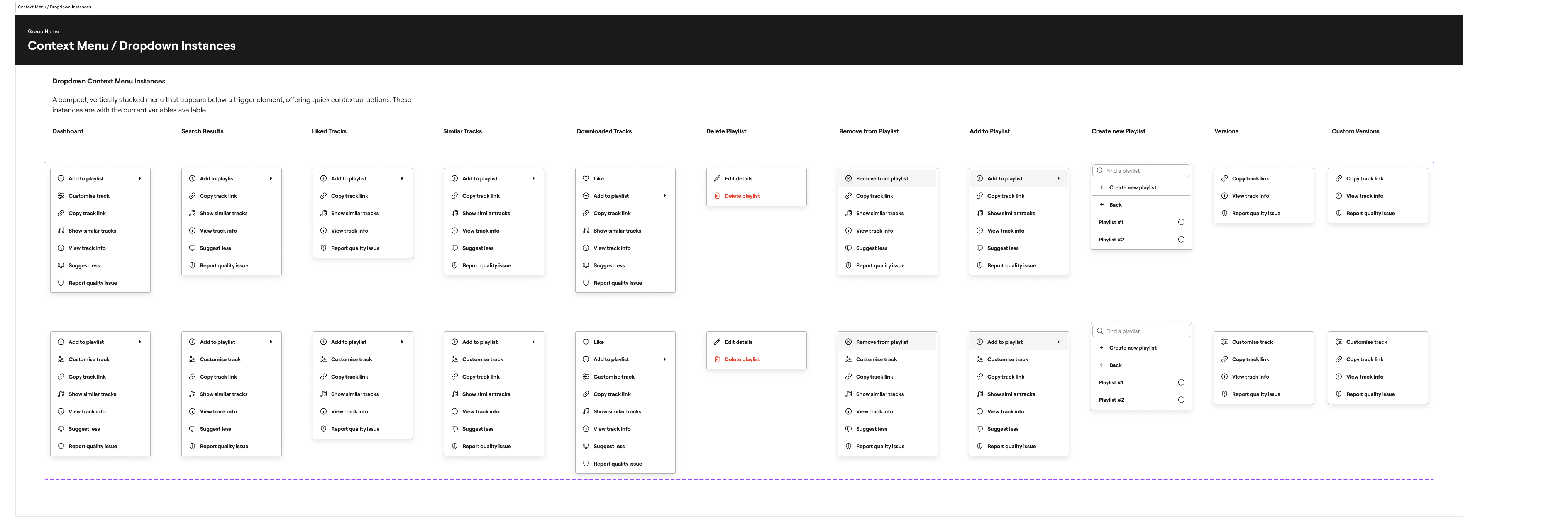
Due to more and more features coming in especially for smaller viewports, we devised a nested menu to reduce cognitive overload with too many icons popping up which might confuse users. Unfortunately due to lack of dev resources, we only got to incorporate part of it within the ProTunes One platform. Ideally it would have behaved differently depending on where the user is accessing content from, which either extends or truncates the menu with more items relevant to their actions.

Smart Version Editor
Allows users to extend or reduce track length, especially useful for content creators with short videos or those who want to have a seamless looping audio track for longform videos. The AI technology splits the track's loops in the background and stitches the track together, so a user can simply plug and play the audio track to their video project without complicated audio cutting tools.

Improvements with Dashboard/Explore Page
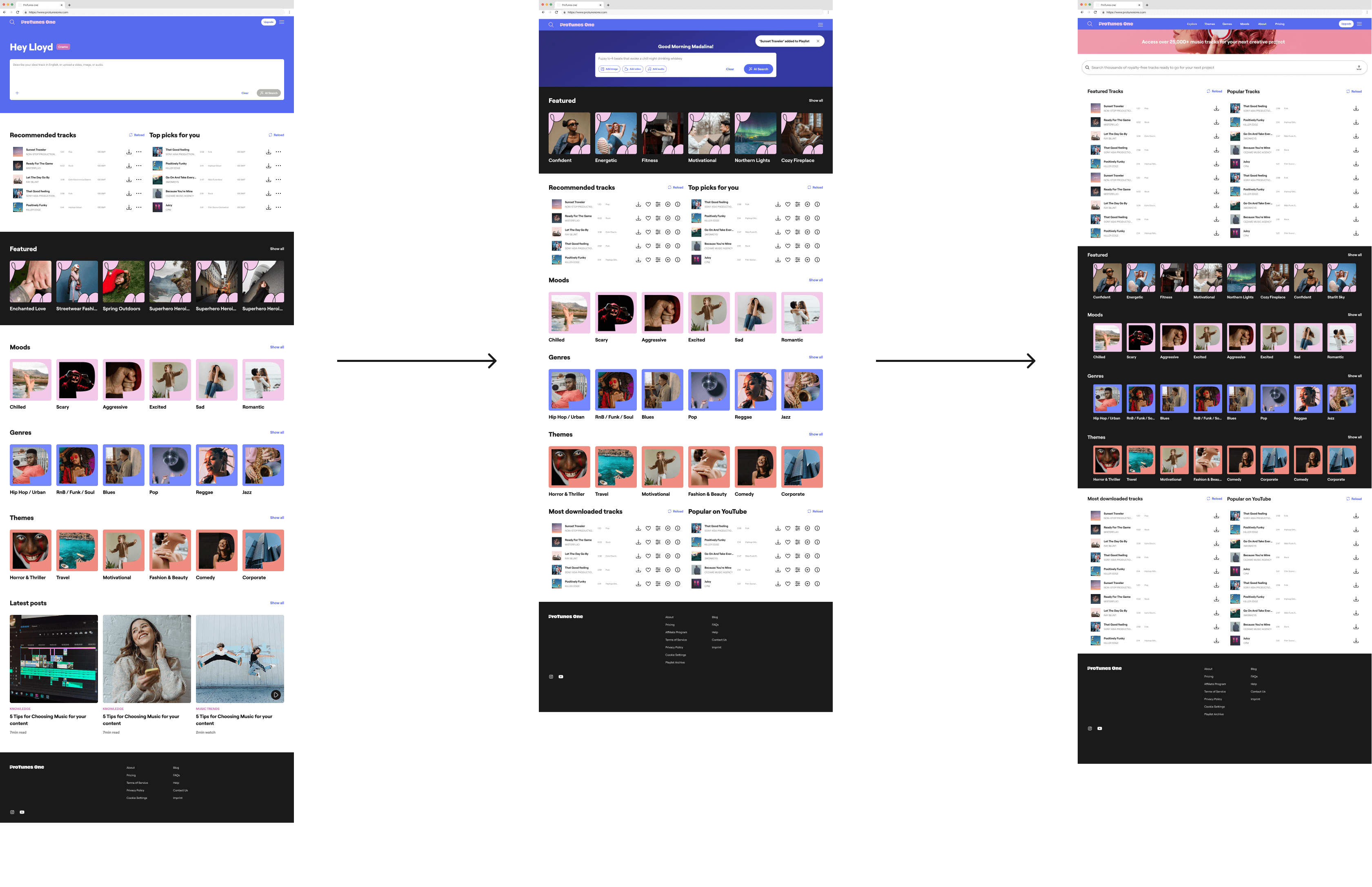
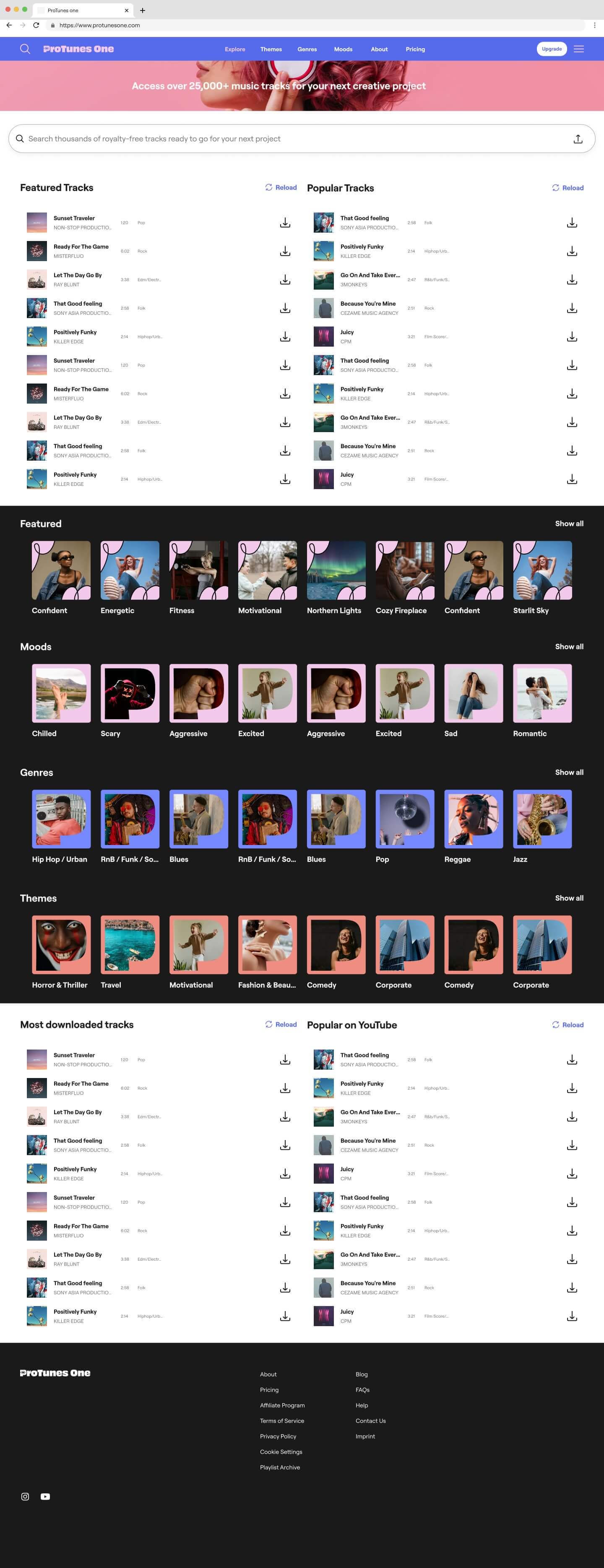
One of the key complaints and as a reactionary action was that the user Explore page had too much white space that prevented (mostly) desktop users to see more items on the first fold. This was especially a problem for users being driven from ad platforms, that they didn't see much to explore which caused significant dropoffs. Upon doing multiple iterations, we settled for a more comprehensive view and a minimalized search bar. The expanded bar was because our search functionality previously worked as prompt-based before we shifted to a new LLM - which improved the overall user experience and provided better search results.
Revision of Album Cover Artworks, via Prompt Engineering
Transitioning from Hardcoded landing pages to Webflow
One of the main internal painpoints from the marketing side at ProTunes One was the limitation to update the landing page whenever there are any offers, updates or new items without the involvement of both frontend and backend teams. I resolved this with the initative to move our marketing-related (meaning outside the product sphere) to Webflow. This was a major improvement with scalability
User Playlists
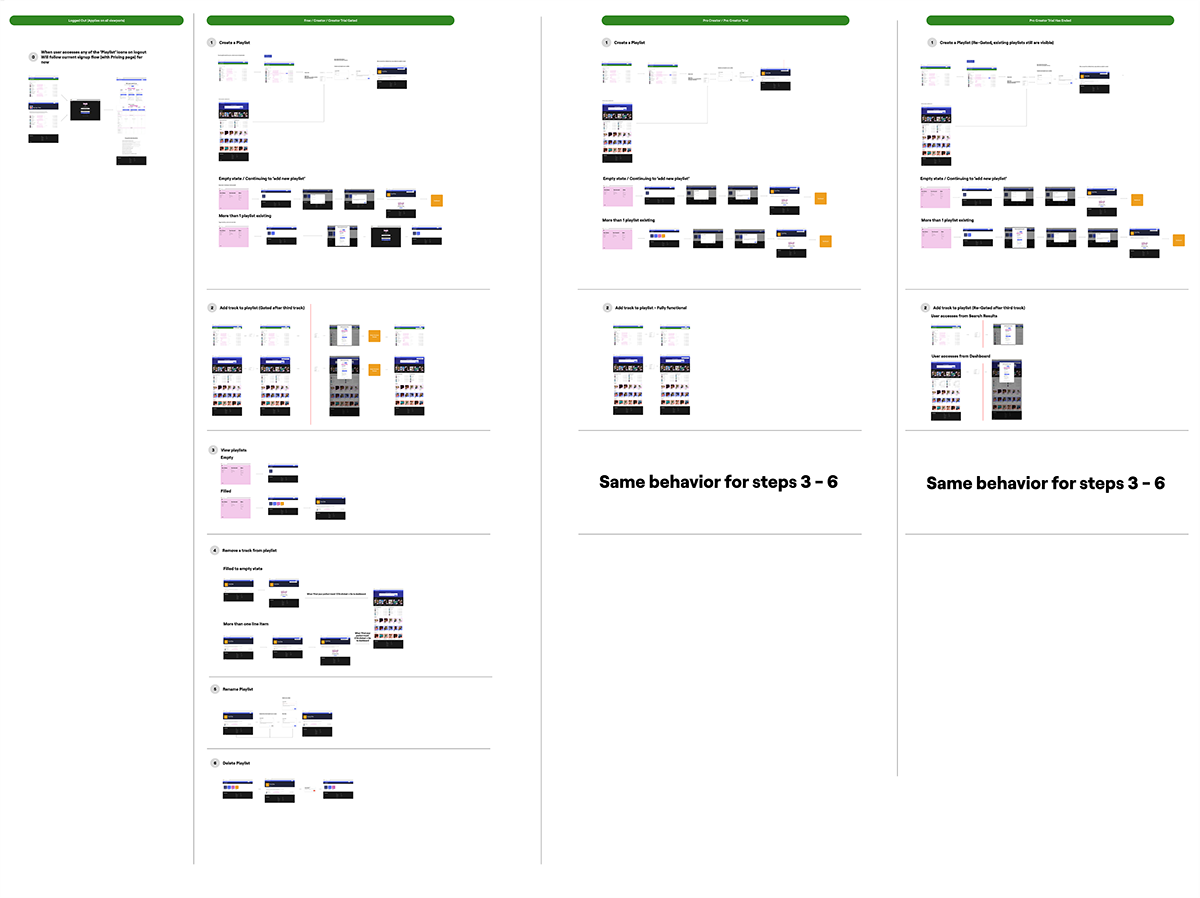
As an attempt to improve user engagement across the platform, we devised 'user playlists'. These also included 'gated' options in an effort to engage users on free tiers to upsell them to get the feature for unlimited playlists which they can save tracks to for future use, share with other users or provide as references to agencies.
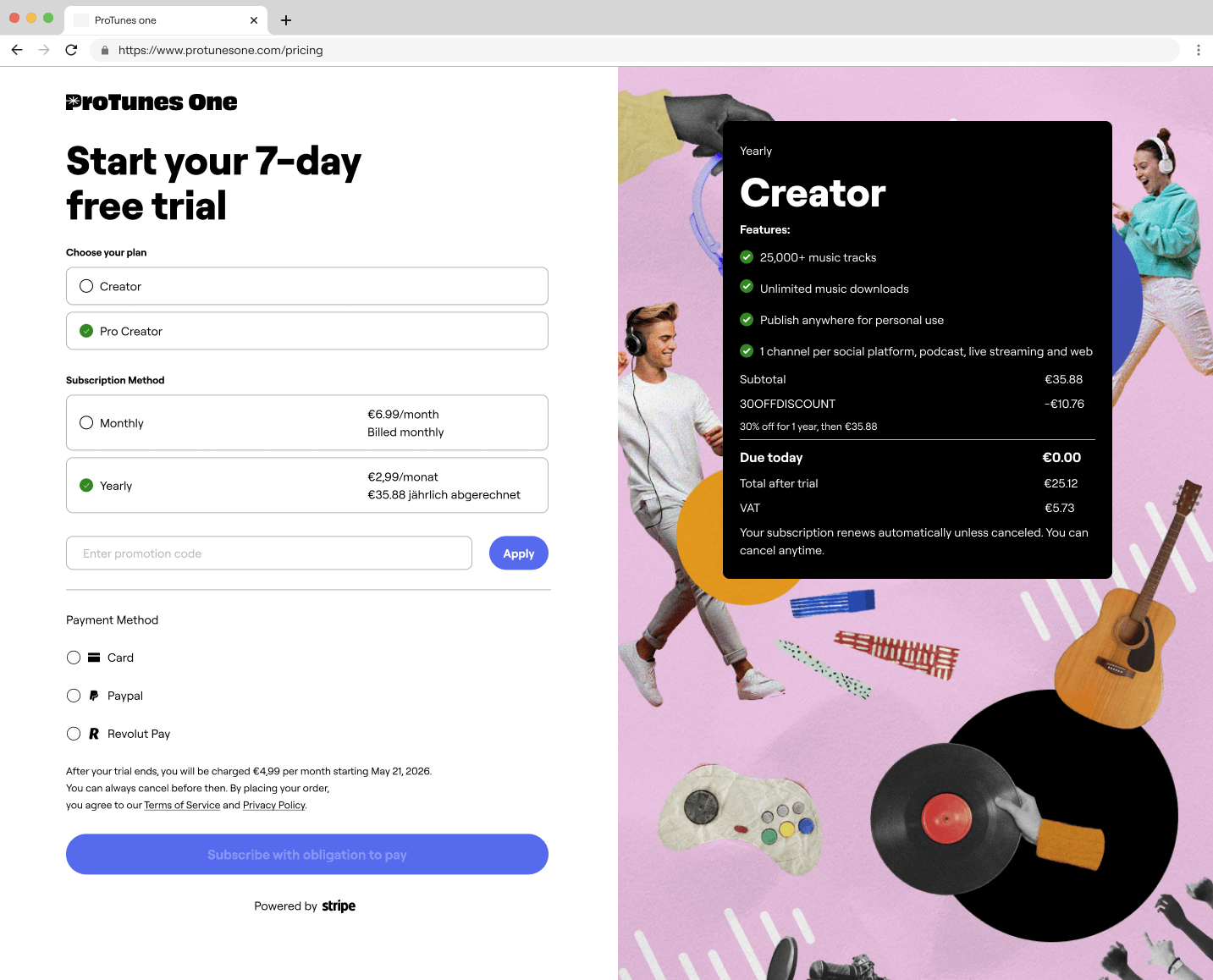
Customized Stripe Checkout
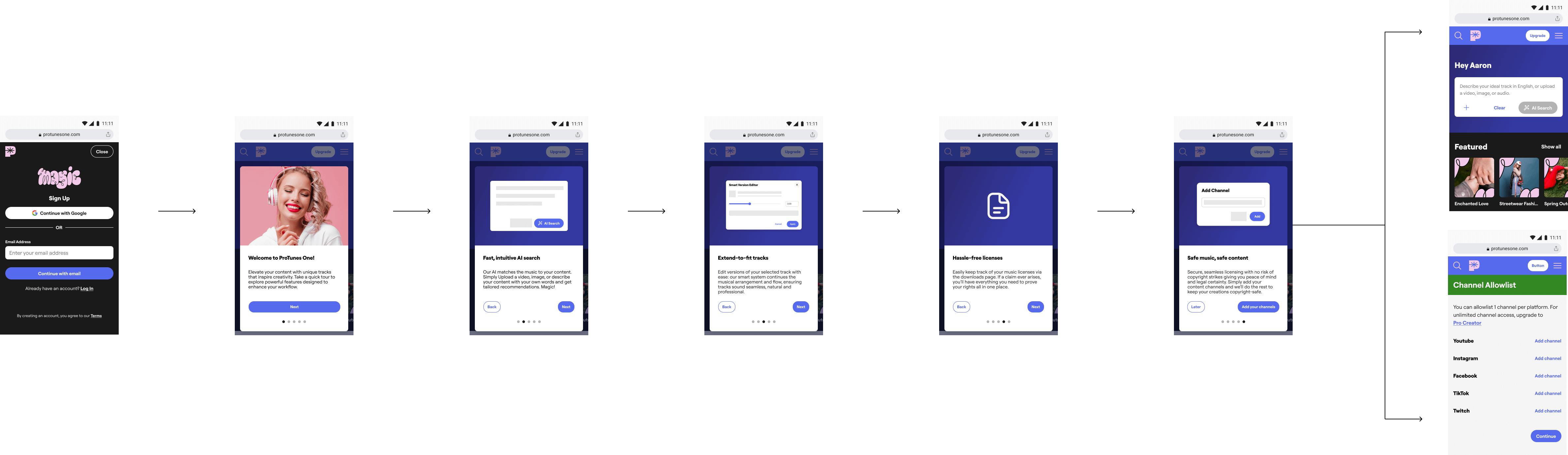
Onboarding Flow
One of the painpoints that we wanted to resolve is for the users to be aware of adding channel allowlists to prevent unnecessary music claims when publishing their content to social media platforms. The allowlist page was difficult to find and was nested deep in the platform's submenu.
With the introduction of the onboarding flow, this improved overall user awareness of why it's necessary to add your channels, and reduced claims significantly.
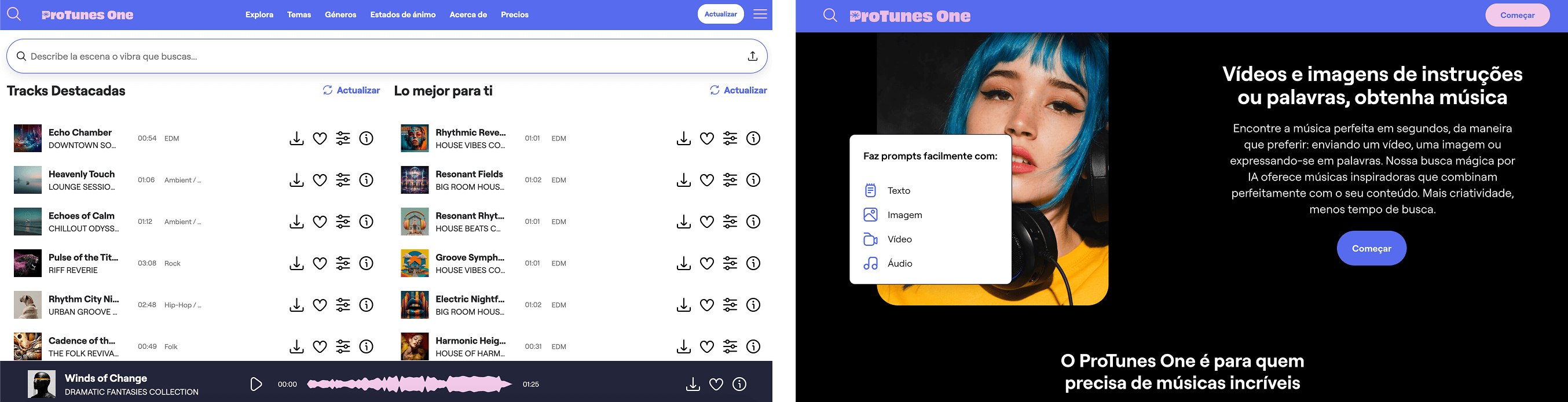
Multilingual Support
Multilingual support for the platform was a big topic, as ProTunes One wanted to increase their global reach. As no one in the team had any experience with this implementation, my first instinct was to do a competitor analysis on translation behaviors, especially when dealing with large amounts of line items and text. We then decided which parts of the platform needed to be tokenized, which ones autotranslated, and which ones would need QA from native speakers.

While other competitors had language switching, not all fields were translated. This turned out as an opportunity for us to go into other markets. Localization eventually became a big project given that we had the front-facing pages and the app itself, to which design and development found a solution by tokenizing content. On the cms-based pages, we then implemented a language translator solution for the Webflow area. This became the gateway for marketing to start targeting ads for various languages and getting more customers outside of the English domain.
Conversion Triggers
[ add content here ]
5. Reactionary Research & Discovery
The R&D process for ProTunes One is more reactionary/pragmatic rather than following traditional UX process. As I already inherited base functionalities when I came in, the research came in form of feedback rounds both qualitative/quantitative and a chunk of competitor research as well as investigating user behavior on-app.
UX Audit
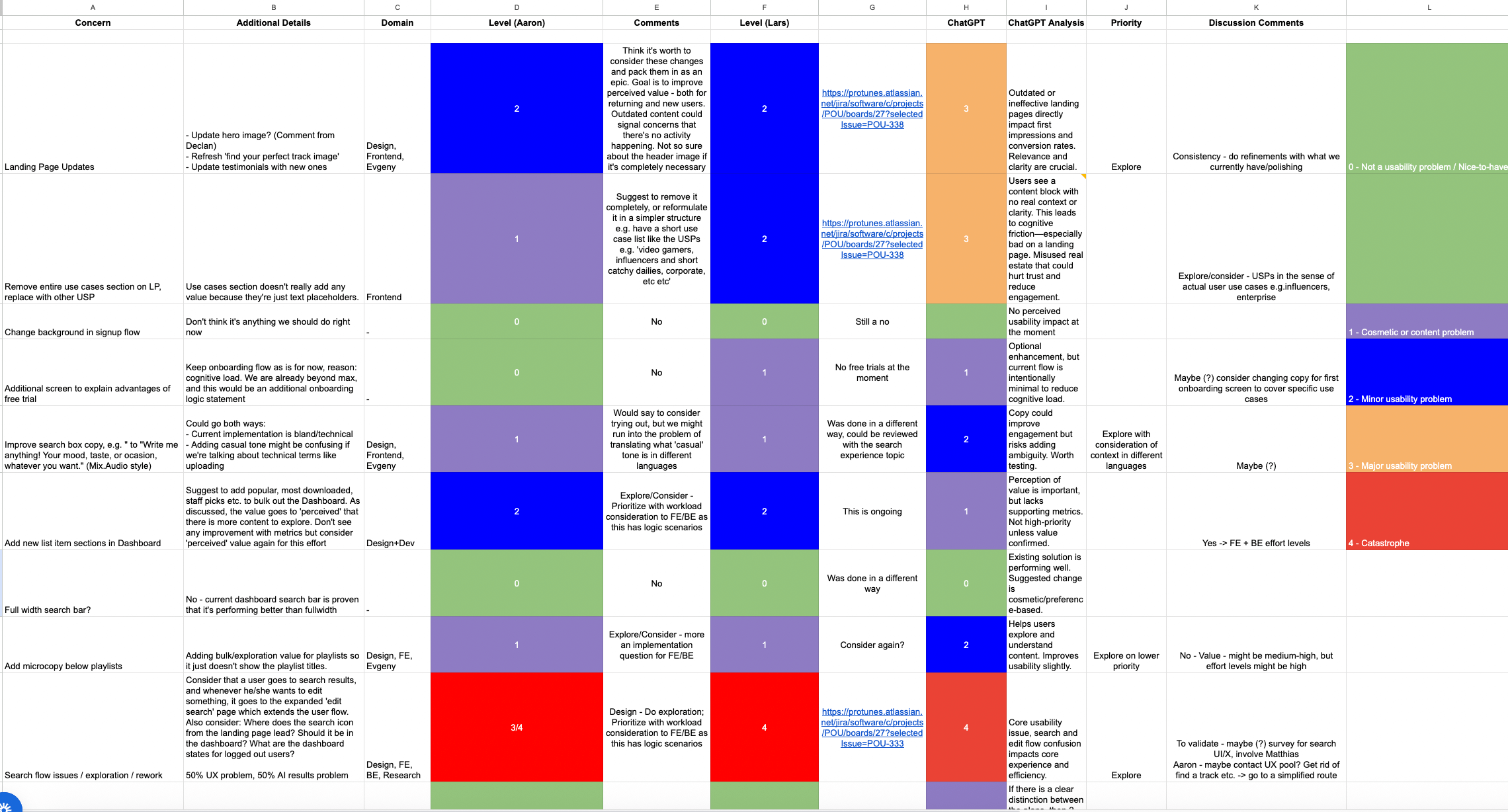
Given that I came into the company with an existing product, the first step for me was to look into the product itself and potential improvements with general user experience. In this case, I created a UX Audit based off the Nielsen scale. Given that this was more focused on the perspective of 'fresh eyes' into the product, I proceeded with tabulating things I have noticed that could be usability problems, which we resolved, pushed back or deprioritized. This gave our product team a good overall view of what were potential problems.
As an additional run for validation, I used ChatGPT to give additional feedback prior to tackling these usability concerns.
User Interviews
We've had periodical user interviews based on a pool of existing users that signed up to our callout via popup on the ProTunes one website. The interviews ran for roughly 45 minutes at a time, with a randomized observer from the team accompanying me during the interviews. The goal was on how to further improve the existing product as well as focus on purchase drivers.
Structurally, I did the interviews together with my team in segments:
- Background information
- Platform
- Purchase driver & triggers
- Names have been changed for anonymity.
We then classified from a sample set of 10 interviewees into categories (Pro user, Casual creator, Beginner creator).
Qualitative Research (Recurring)
Eventually, we reduced the budget for live user research due to budget constraints. We have set up a series of continuously running surveys triggered by user events in-app and tracked submission data via Hotjar and Mixpanel, to which I did monthly analysis to cover key user pain points:
A. User Dropoffs/Cancellations
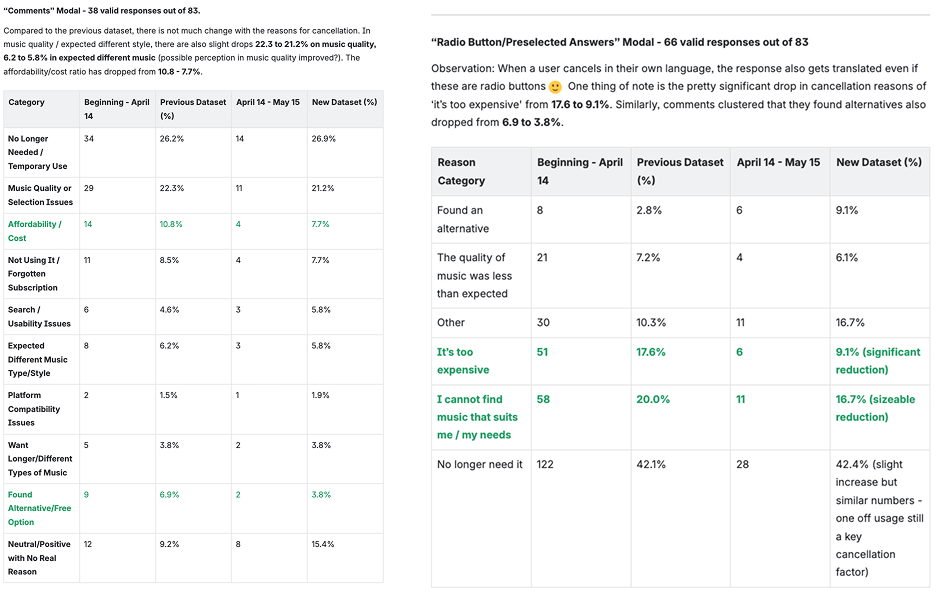
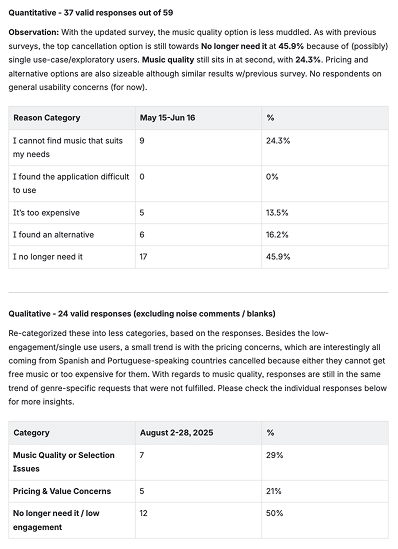
The survey was set up whenever a user cancels their account, in order to look for improvements from the product side.
Trends
- Almost 30-50% total of actionable cancellations cite issues with music quality or selection.
- Usage Intent Dominance: Cancellations are still due to project-based or one-off needs.
- Reduction of Genre-specific cancellations, or student-related requests: Finals week was over from last check, and there are just a couple comments on genre-specific music on this round, responses more generalized that they didn’t find what they wanted.
- Compared to earlier trends (where “No longer needed” usually dominates and quality concerns are more niche), this signals a rise in expectation mismatches. Attribution: First time users not given the chance to explore before committing
- No longer need it’ - still remains as the biggest response for both quantitative/qualitative.
- An increase in genre-specific requests - Japan-related (cyberpunk) / kpop / anime / gaming subniches of music are performing pretty well.
- Student Market - This month specifically, there were quite a bit of cancellations due to users using the tracks for student projects (could be attributed to university finals weeks?) - considerations on student plan
Most of the concerns for cancellation were pointing out either to a single-use case (one project only) or due to the quality of music - which was feedback taken in by the R&D team.
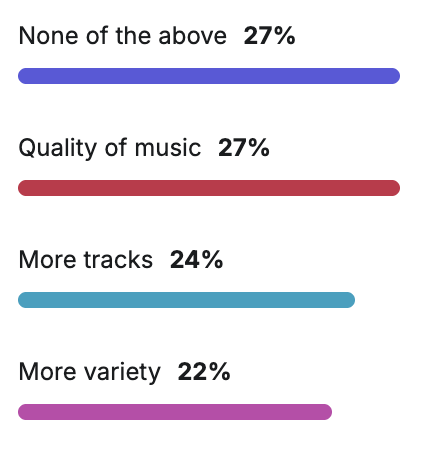
B. Playlist Content Perception
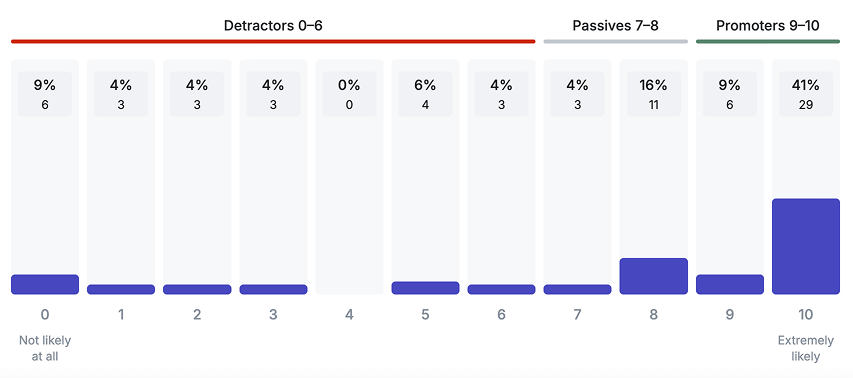
C. Net Promoter Score Survey
D. Hotjar and Mixpanel Heatmaps
I set up routine Hotjar heatmaps for our most frequented pages to analyze user activity. These gave us valuable insights with hotspots, user behavior on features that are being constantly used or not. The constant checks allowed us to deprecate lesser used features to save on page real estate, and reorder content.
These also gave into insights for example which playlists have the most activity so we can generate more in the same line, considering placement of promotional banners/offers and do A/B tests with copy and/or visual changes.
For example in previous versions of the search bar
.jpg)
6. RESULTS & IMPACT
As previously mentioned, my design efforst have contributed to:
- Reaching 100,000 subscribers and 50,000 active subscribers milestones during my stay
- Securing additional €1,5 million seed funding from sole investor
- Improved free-to-paid conversion rate to 33%, up from 24% at the start of the year.
- Introduction of contextual and visual A/B tests across the platform which improved CTR's by up to 20%
- Lowered monthly churn to 2.4%, supported by clearer licensing, better recommendations, and playlist retention mechanics.
- Expanded reach to additional non-English markets by introducing multilingual support (DE, NL, IT, ES, PT)
7. RETROSPECTIVE
During my time at ProTunes One, I have:
- Owned end-to-end product design for key user-facing features, from research to interaction design to polished UI, often working without a dedicated design counterpart.
- Drove the new playlist creation flow aimed at boosting Pro Creator subscription value.
- Built scalable frameworks for categorizing user feedback and incorporating AI work, especially around cancellations, using reusable, structured templates and decision trees.
- Shaped investor-facing narratives, evolving the product story and visual identity across pitch materials while maintaining brand consistency.
- Acted as the design voice in cross-functional decisions, connecting business goals, user reality, and tech constraints into clear, actionable product direction.
8. Addendum
Company Values
ProTunes One's commitment:
- Safety and security: Provides legally cleared, 100% rights-cleared music to prevent copyright issues for users.
- Transparency and fairness: Ensures fair compensation for music creators through transparent revenue sharing models and clear fee structures for licensing.
- Partnership with creators: Positions itself as a partner that understands and serves the needs of content creators.
- Simplification: Aims to simplify the complex processes of music discovery, licensing, and rights management through an all-in-one platform.
- Quality and innovation: Takes pride in the quality of its tracks and uses AI-driven search to provide the right music for projects.
Credits
Design Ownership: Aaron Roselo
Prototypes, Design Systems, Webflow/Front-Facing Pages, Brand & Marketing Assets, User and Competitor research, Product Analytics
Key Collaborators:
Marketing - Evgeny Stroh
Product Manager - Alexander Manger
Frontend/Backend Developers - Madalina Fabrazi, Steffen Tischer, Frank Fabig
CPO - Lars Fabig
Data Science/Music - Matthias Eichner, Amjad Samour
Other Projects


rückla
Self-directed case study: rueckla, a speculative digital banking app for intuitive financial management. Ran the full UX process end to end, research, testing, and a high-fidelity prototype, to demonstrate process depth outside client work.
ecolytiq
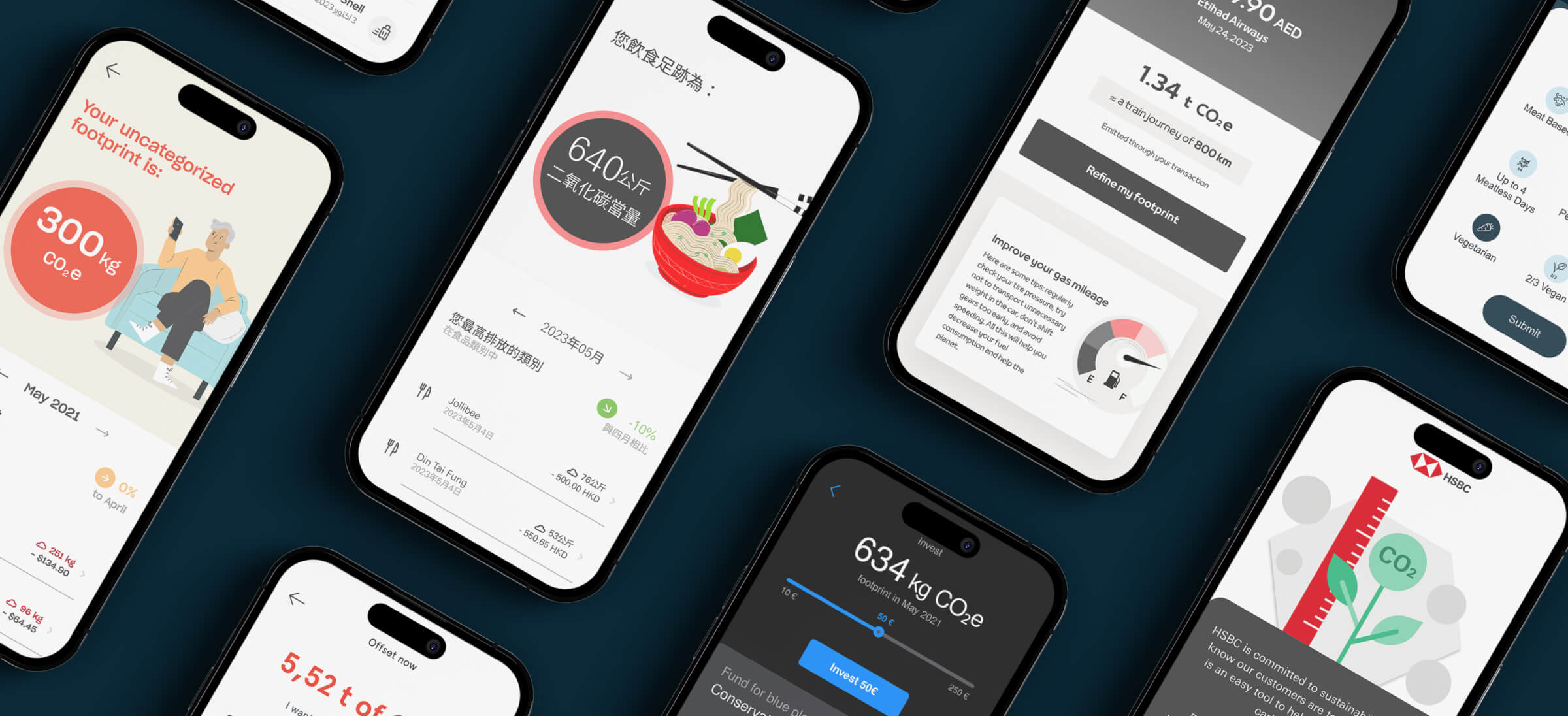
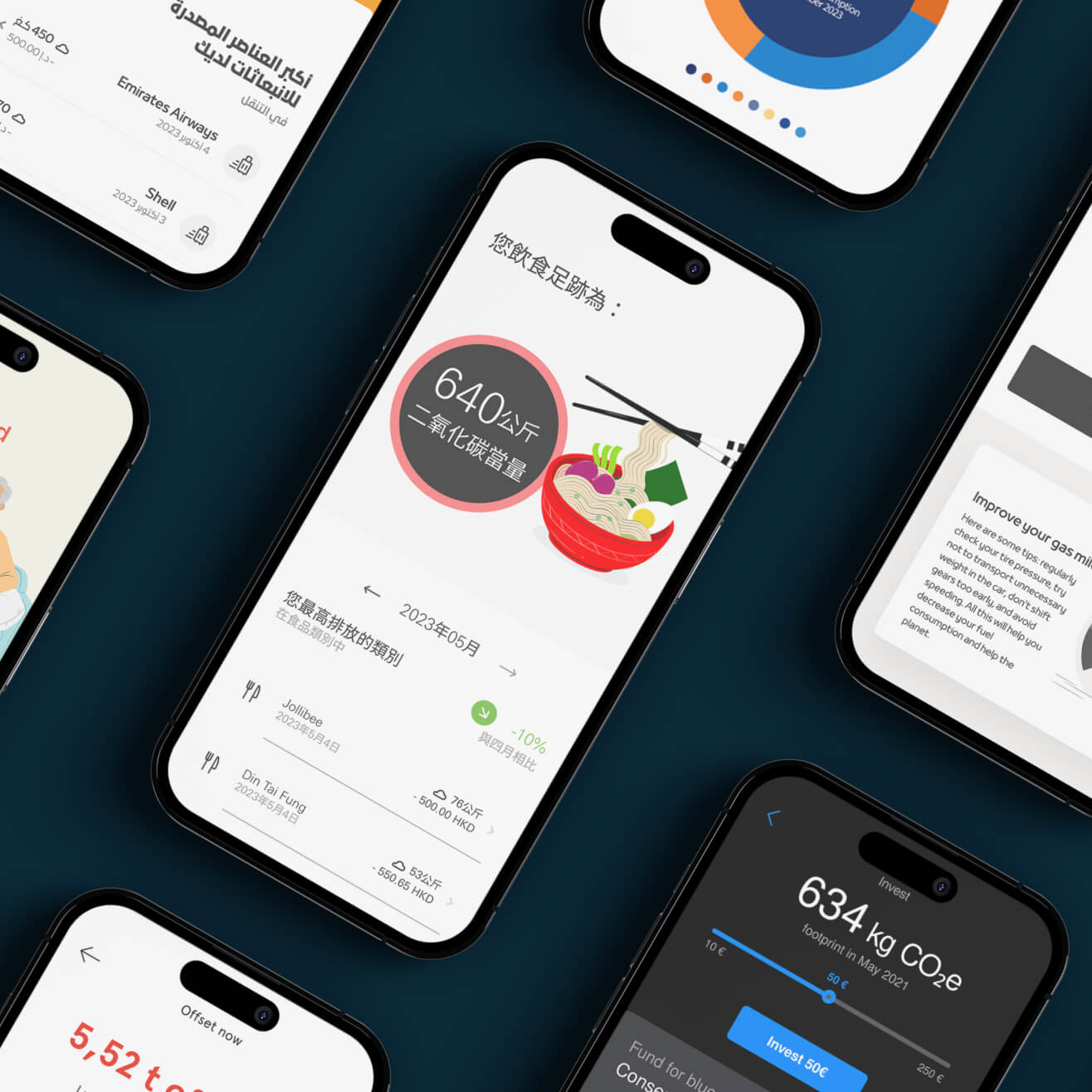
Sole senior UX designer for ecolytiq, a sustainability-as-a-service platform used by banking clients including HSBC and Mashreq, reaching 33 million consumers and helping avoid 520,000 tons of CO2e.